When a terrified man keeps stumbling into victory — against a tiger, an army and a man‑eating crocodile — an entire kingdom crowns him a hero. Kong Hean’s story asks: is courage what you are, or what people believe you to be?
Kong Hean’s legend is, at heart, the story of a man whom chance keeps mistaking for a hero — and of a society very willing to believe the mistake.

The making of a “tiger killer”
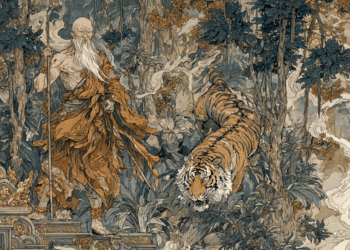
Long ago, a man named Kong set out with his two wives, Neang Am and Neang Kom, to visit relatives in a distant village. Their path led through a forest notorious for a man‑eating tiger that had been attacking villagers and livestock. As they entered the thick of the trees, the tiger suddenly charged, roaring toward them.
Kong bolted for the nearest hollow tree and wedged himself inside, shaking so violently with fear that his body lost control of itself. His wives, left in the open, did the only thing they could: they grabbed sticks and stones and, working together, beat the tiger until it lay dead.
Only then did Kong emerge. Seeing the lifeless animal, he snatched up a club and began striking it with great vigor, as if delivering the decisive blows. When Am and Kom mocked him — “The tiger was dead already; what kind of man arrives late to beat a corpse?” — he snapped back that women could never kill a tiger, and that only men possessed such courage.
Kong tied the tiger with forest vines and dragged it into the village. People crowded around, amazed that their neighbor had caught the dreaded beast. The wives tried to tell the real story, but Kong overrode them, demonstrating imaginary fighting moves and insisting he had used a special secret technique. The villagers, impressed more by performance than by evidence, believed him. They named him Kong Hean — Kong the Brave — and word of his supposed prowess soon reached the king. Kong was summoned to court and rewarded with rank as a military commander.

The nervous general
His test came sooner than he wished. When an enemy force marched against the kingdom, the king ordered Kong Hean to lead the army into battle. Terrified, Kong went home and lay staring at the ceiling, unable to eat. When his wives asked what was wrong, he admitted he dreaded the coming war but did not know how to refuse the royal command, especially now that he was famous for bravery.
They urged him to pull himself together: eat, bathe, dress for war, and trust that things would somehow work out. Bolstered more by necessity than conviction, Kong did as they said. He returned to court, took ceremonial leave of the king, and set off for the front, riding the lead war elephant with his wives seated behind him and ranks of soldiers marching in formation all around.
As the enemy lines came into view, Kong’s fear surged. He shook so hard that the elephant mistook his trembling for the signal to charge and lunged forward, leaving the rest of the army behind. At the same moment, Kong’s body once again betrayed his terror, staining the elephant’s head as they hurtled alone toward the enemy.
From the enemy’s perspective, however, this looked like breathtaking courage — a lone general on a war elephant, launching a reckless, direct assault. Panicked, they broke ranks and fled. By the time Kong’s own troops caught up, the battle was already won.
Seeing the state of the elephant, some officers discreetly asked what had happened. Kong, now on the winning side of events, replied coolly that in real combat, a commander had no time to dismount for bodily needs; one relieved oneself where one stood, or died. Some listeners instantly recognized fear wrapped in bravado; others, less perceptive, took this as the ultimate proof of his fearlessness.
Back in the capital, the king heard that Kong Hean had routed the enemy and scattered their forces. He rewarded his “hero” with more honors, more wealth, and higher title. Kong, buoyed by royal approval and public admiration, leaned even further into his role as the kingdom’s indispensable champion.

The crocodile that promoted a man
Not long after, trouble emerged in another form. A huge crocodile began attacking people along a busy stretch of river. Traders no longer dared travel by boat; villagers stopped swimming and bathing; river life, in every sense, was blocked. Distressed subjects petitioned the king, who again turned to the man he believed capable of anything: Kong Hean.
The new assignment — catch the crocodile — left Kong as shaken as any battlefield. At home, he confided to his wives that, on land, at least he could see danger coming, but in water he felt doomed. The king’s order, though, left him no room to refuse. In grim resignation, he gathered his nephews and young relatives under the pretext of “going to catch the crocodile.” Word spread, and crowds flocked to the riverbank to watch the famous general at work.
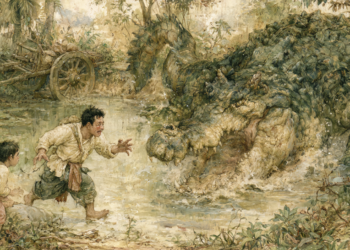
They found the crocodile patrolling near a spot where two trees grew close together, their branches forming a fork above the water. Deciding this was as good a place as any to die, Kong leapt from there into the river. The crocodile, startled by the sudden splash, tried to escape and instead flung itself upward into the forked branches, wedging its body between them. It hung there, trapped — unable to move forward or back.
Kong surfaced, saw the crocodile helplessly pinned against the trees, and immediately shouted to his nephews to bring spears and axes. Together, they killed it easily. On the bank, the crowd had missed the crucial physics of panic and branches; what they believed they had witnessed was something else entirely: Kong Hean, diving into the river, seizing the crocodile and hurling it up into the tree.
The legend grew in the retelling. Back at court, Kong reported simply that he had captured the crocodile and thrown it up onto dry land. The king, relieved and deeply impressed, elevated him yet again, granting more authority and more rewards.
In the end, Kong Hean stands as one of folklore’s most ironic heroes: a man propelled up the social ladder by fear, accident and misinterpretation, carried along by a public eager for saviors and a ruler happy to have one — so long as the stories keep turning out well.
Other Khmer stories on Wonders of Cambodia:
The Towers of Exile: the Story of Neang Khmau
Moranamātā – The Daughter of the Dead Mother
Ta Trasak Ph’aem: Cambodia’s Sweet Cucumber King