Tucked away in the vast sacred landscape of Preah Khan Kampong Svay, Prasat Damrei – the “Elephant Temple” – is a stepped pyramid crowned by monumental stone elephants and wrapped in laterite walls and forest. This article introduces its history, architecture and atmosphere, and offers practical advice for travelers who dream of exploring remote Angkorian temples beyond the usual circuits.
Whether you are a temple enthusiast, a photographer chasing quiet ruins, or a cultural traveler interested in the Khmer Empire’s frontier sanctuaries, Prasat Damrei rewards the effort it takes to reach it. You will learn how it fits into the huge Preah Khan Kampong Svay complex, what makes its elephant sculptures unique, and how to plan a safe, meaningful visit in today’s rural Cambodia.

Where is Prasat Damrei and why it matters
Prasat Damrei (Khmer: ប្រាសាទដំរី) is a satellite temple of the immense Preah Khan Kampong Svay complex (also known as Prasat Bakan), located in present‑day Preah Vihear Province, around 100 km east of Angkor. The complex is one of the largest religious ensembles of the Angkorian era, with outer enclosures stretching over roughly 20–25 square kilometers.
The pyramid of Prasat Damrei stands near the northeastern corner of the grand baray, several kilometers from the central sanctuary of Preah Khan. This location suggests a carefully planned ritual landscape, where water, causeways, barays and pyramids symbolized the cosmic order around a royal or religious center. For visitors today, it also means travelling through rice fields, sparse villages and forest tracks to reach a truly off‑the‑beaten‑path site.

Between Prasat Damrei and the main temple lies a huge baray, approximately 2.8–3 km long and 0.6–0.75 km wide, with an artificial island (mebon) at its centre. In Angkorian symbolism, such barays evoked the cosmic ocean surrounding Mount Meru, the mythical axis of the universe, while the mebon served as a sacred island shrine. Prasat Damrei’s position at the edge of this reservoir underlines its role in a broader ritual and hydraulic network rather than as an isolated monument.
Preah Khan Kampong Svay was developed over several reigns, mainly under kings Suryavarman I, Suryavarman II and Jayavarman VII between the 11th and early 13th centuries. The overall complex shows a mix of architectural styles, from earlier sandstone sanctuaries to Bayon‑style towers and later Buddhist additions.
Prasat Damrei itself is generally considered part of this Angkorian program, with a stepped pyramid layout reminiscent of other state temples such as East Mebon and certain baray‑related shrines. Its elephant statues at the upper corners echo the iconography of East Mebon, where elephants also stand at each corner of the platform.

From Hindu origins to living shrine
The original deity of Prasat Damrei is not known with certainty, but its pyramid form, association with baray symbolism and elephant imagery point to a Hindu context linked to royal cults or guardian deities. Today, locals have transformed the site into a living shrine dedicated in particular to Ganesha, the Hindu elephant‑headed God who remains popular in Buddhist Cambodia. Offerings at summit of the pyramid and around the surviving elephants show how ancient temples continue to absorb new spiritual meanings over centuries.

Architecture of the Elephant Temple
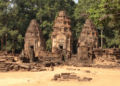
Prasat Damrei is a roughly 15‑metre‑high stepped pyramid constructed mainly in laterite, once surrounded by a laterite enclosure wall. The monument rises in successive terraces, accessed by staircases on each side which were originally flanked by lions and devata sculptures. Time, looting and weather have damaged many of these details, but enough survives to suggest an impressive, tiered appearance when the temple was intact.

At each corner of the upper platform stood large stone elephants, carved at life‑like scale and facing outward as guardians of the four directions. Two of these elephants remain in situ, heavily weathered but still atmospheric against the forest backdrop. The other two were removed and are now displayed at the National Museum in Phnom Penh and at the Musée Guimet in Paris.
Entrances, terrace and decorative details
Around the base of the pyramid, the laterite enclosure was pierced by sandstone gateways, some with false doors and one true entrance opening to the north. On this side a long cruciform terrace stretches out, lined with naga‑balustrades and decorated end stones, including a finely carved Garuda gripping a serpent that still remains in place. The devata figures flanking the doorways and the decorative lintels on the gateways display a style worthy of close study for visitors interested in Angkorian iconography.

Inside, the summit would once have housed a small sanctuary or platform dedicated to the temple’s main cult image, now lost. Even in its ruined state, the combination of pyramid, elephants, naga terrace and surrounding landscape creates a powerful composition that feels both monumental and intimate.
Reaching Prasat Damrei is part of a wider journey to Preah Khan Kampong Svay, which lies in a remote area of Preah Vihear Province far from the main tourist centers.
Because of the distances and road conditions, many travelers choose a 4×4 vehicle or motorbike with an experienced local driver or guide. Organized day trips from Siem Reap exist but usually involve long driving hours, often 8–10 hours round‑trip depending on the season and stops. Some visitors prefer to overnight in or near the area to explore at a more relaxed pace, combining Prasat Damrei with the central Preah Khan sanctuary and other satellite temples such as Preah Thkol and Preah Stung.
Do not expect ticket offices, cafés or crowds: Preah Khan Kampong Svay and Prasat Damrei remain among the least-visited major Angkorian sites. Paths may be overgrown, structures partially collapsed and signposting minimal, which is part of the “lost temple in the jungle” appeal but requires more self‑reliance. At Prasat Damrei, you will likely find only a small shrine, traces of incense and offerings, and the two surviving elephants gazing silently over the forest.
Photography enthusiasts will appreciate the play of light on the laterite blocks, the silhouettes of the elephants against the sky and the reflections when seasonal water collects around the base. For culturally minded visitors, time spent observing local worship practices – from simple offerings to Ganesha to the way villagers treat the site with quiet respect – can be as revealing as the architectural details themselves.
Practical tips for a meaningful visit
A visit to Prasat Damrei is best suited to travelers who are comfortable with long drives, basic conditions and flexible plans. Here are some practical suggestions to make the most of the experience:
- Travel in the dry season if possible, roughly November to April, when tracks are more passable and access to remote corners of the complex is easier.
- Hire a local guide or driver familiar with the area, both for navigation and for up‑to‑date information on road conditions and any access restrictions.
- Bring water, snacks, sun protection and basic first‑aid supplies, as services on the approach roads and near the temples are minimal.
- Plan to combine Prasat Damrei with the main Preah Khan sanctuary and the baray mebon (Preah Thkol) to understand how the pyramid fits into the overall sacred landscape.
Respecting a living sacred place
Although Prasat Damrei is an archaeological site, it also functions as a living shrine for nearby communities. Dress modestly, avoid climbing on delicate carvings, and step carefully around offerings such as incense sticks, flowers or food left at the base of the pyramid or near the elephants. A small donation at a local shrine or to community initiatives, when appropriate, can help maintain goodwill and support the people who keep watch over these fragile remains.
Why Prasat Damrei deserves a place on your itinerary
For many visitors to Cambodia, Angkor Wat and Bayon provide more than enough wonder; yet for those who have time and curiosity, Prasat Damrei offers a different kind of encounter. Here, the scale is smaller but the sense of remoteness is greater, and the silence around the elephants speaks volumes about the longevity of Khmer sacred landscapes.
Standing before the worn but still imposing elephant statues, you touch a point where royal ambition, water management, religious devotion and rural belief intersect across nearly a thousand years. For travelers interested in going beyond the postcard view of Angkor, Prasat Damrei at Preah Khan Kampong Svay is a compelling stop that connects the grandeur of the empire with the quiet persistence of local faith.
Sources & further reading / To know more
- Preah Khan Kompong Svay – Wikipedia – General overview of the complex’s history, layout and major satellite temples, including the baray and Prasat Damrei.
- UNESCO World Heritage Centre – Preah Khan Kompong Svay – Tentative list description with historical context, art styles and significance of the wider archaeological landscape.
- Hello Angkor – Preah Damrei – Short site profile with architectural notes, on‑site observations and detailed descriptions of the elephants and terrace carvings.
- Sailingstone Travel – Preah Khan of Kampong Svay – In‑depth travel narrative explaining how to visit the complex, with a dedicated section on Prasat Damrei and practical advice.
- Guided tour pages (various operators) – Sample day‑trip itineraries from Siem Reap with road descriptions, suggested stops and travel times to Preah Khan Kampong Svay.
Prasat Damrei at Preah Khan Kampong Svay is a remote Angkorian pyramid where stone elephants still guard a sacred baray landscape, far from the crowds yet deeply rooted in Cambodia’s living spiritual traditions. For travelers willing to venture off the main routes, it offers a powerful blend of archaeology, landscape and quiet local devotion that lingers long after the journey back along dusty provincial roads.
Pascal Médeville is a writer and digital publisher who focuses on Cambodian history, sacred architecture and the everyday culture of Southeast Asia. He regularly publishes in‑depth articles on remote temples, spiritual practices and cultural landscapes, helping readers connect famous sites like Angkor with lesser‑known places such as Preah Khan Kampong Svay and Prasat Damrei.