Introduction: Organizing the Chaos
The Angkor Archaeological Park covers 400 square kilometers, containing scores of temples. To make this navigable, French conservators in the 20th century standardized two loop roads: the Small Circuit (Le Petit Circuit) and the Grand Circuit (Le Grand Circuit).
These are not just transport routes; they represent two different “moods” of the Khmer Empire. One is monumental and crowded; the other is pastoral and atmospheric.

I. The Small Circuit (Le Petit Circuit)
The “Must-Sees” & The Heavy Stone
This 17-kilometer loop contains the most famous, massive, and intricately carved temples. It focuses on the sheer power of the Khmer kings, featuring the largest state temples from the 12th and 13th centuries.
Distance: ~17 km
Time: 6–8 hours
1. Angkor Wat (The Masterpiece)
The largest religious monument in the world. While famous for its five lotus towers, the real treasure is in the East Gallery. Here, you will find the Churning of the Ocean of Milk, a 49-meter bas-relief depicting 92 demons and 88 gods playing a cosmic tug-of-war with a giant serpent to release the elixir of immortality. It is the finest carving in the entire park.

2. Angkor Thom (The Great City)
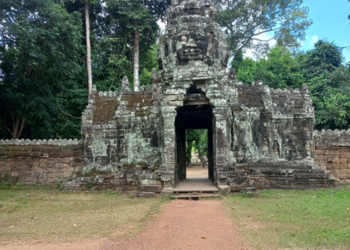
You enter through the South Gate, flanked by 54 gods and 54 demons holding the body of a Naga (a 3D representation of the Churning myth). Inside the walls, you visit:

- Bayon: The state temple of King Jayavarman VII. It is defined by its 54 Gothic towers adorned with 216 enigmatic, smiling stone faces.
- Baphuon: A massive 11th-century pyramidal temple. Walk around to the west side to see a colossal Reclining Buddha (9 meters tall, 60 meters long) constructed from stones of the temple itself centuries later.
- Terrace of the Leper King: A viewing stand with a secret. There is a “hidden wall” inside the trench—a secondary wall of carvings that was covered up when the terrace was expanded, leaving the Apsara and demon carvings in perfect condition, shielded from the rain for centuries.
3. Ta Keo (The Unfinished Mountain)
A massive sandstone pyramid that was never decorated. It looks like a brutalist skeleton of a temple. Because it lacks carvings, you can clearly see the raw engineering skills used to stack the massive green sandstone blocks.
4. Ta Prohm (The Jungle Temple)
Left in a state of “picturesque neglect,” this is where the Strangler Fig and Silk-Cotton trees have become part of the structure. The most famous spot is the “Crocodile Tree,” whose roots drip over a corridor wall like melting wax.

5. Banteay Kdei (The Citadel of Chambers)
A monastic complex that feels like a smaller, more confused Ta Prohm. Look for the Hall of Dancers near the entrance, where pillars are decorated with dancing Apsaras (many defaced during the anti-Buddhist reaction of the 13th century).
II. The Grand Circuit (Le Grand Circuit)
The “Explorer’s Loop”
This 26-kilometer loop extends north and east, visiting temples that served specific social functions (universities, hospitals) and showcasing the transition from brick to stone architecture.
Distance: ~26 km
Time: 4–6 hours
1. Preah Khan (The Sacred Sword)
Built as a fusion of city, temple, and Buddhist university (with over 1,000 teachers). Unlike the mountain temples, this is flat and sprawling.
- Key Detail: The “Hall of Dancers” friezes and the unique two-story Greek-style pavilion (which looks completely out of place in Khmer architecture).
- Key Detail: As you walk toward the sanctuary, the doorways get progressively lower, forcing you to bow your head in respect.

2. Neak Pean (The Entwined Nagas)
A small circular island temple located in the middle of the Jayatataka Baray (reservoir).
- Function: It was an ancient hospital. The central pool represents the mythical Lake Anavatapta. Four smaller pools surround it, connected by gargoyles representing the Elephant (Water), Bull (Earth), Horse (Wind), and Lion (Fire). Pilgrims would bathe in the pool corresponding to their ailment to balance their “humors.”
3. Ta Som (The Miniature Ta Prohm)
A small, quiet temple.
- Key Detail: Walk all the way to the Eastern Gopura (Gate). It is completely swallowed by a massive Ficus tree. Unlike Ta Prohm, you can often stand here alone for 10 minutes without seeing another tourist.
4. East Mebon (The Island Temple)
This 10th-century temple originally stood on an island in the (now dry) East Baray.
- Key Detail: The Monolithic Stone Elephants. Standing at the corners of the first and second tiers, these 2-meter tall elephants are carved from single blocks of stone and are incredibly well-preserved.
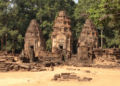
5. Pre Rup (The Crematorium)
A towering brick temple-mountain. The name means “Turning the Body,” referring to the method of rotating a corpse during cremation.
- Key Detail: It is the best spot for sunset on the Grand Circuit. The upper terrace is high above the tree line, offering a view of the sun sinking into the jungle and rice paddies. The brick construction glows a warm red/orange in the late afternoon light.
| Feature | Small Circuit | Grand Circuit |
| Vibe | Monumental, Intense, Crowded | Pastoral, Quiet, Atmospheric |
| Architecture | Massive Sandstone Mountains | Mixed (Brick, Laterite, Hydraulic) |
| Best For | First-timers (“The Hits”) | Photographers & 2nd Day visits |
| Physicality | High (Steep stairs at Baphuon/Ta Keo) | Moderate (More sitting in tuk-tuk) |
Recommendation: If you have two days, do the Small Circuit first (to see the icons), then use the Grand Circuit on day two to recover with a more relaxing, shaded, and peaceful exploration.