Beginnings: A Deity of Union
In the shadowed sanctuaries of pre-Angkorian Cambodia, the figure of Harihara (Khmer: ព្រះហរិហរៈ) materializes as a paradox rendered in stone—a composite of Vishnu the Preserver and Shiva the Destroyer. Here, the Khmer imagination perceived no contradiction in merging the attributes of these divine adversaries. Instead, they sculpted unity, fashioning a god whose very form balanced tension and harmony.

Iconography: The Duality Made Visible
Harihara’s visage is an overt declaration of synthesis. The right profile dons Vishnu’s tall crown—inscribed with the benevolence and sovereignty of order. The left is wreathed in Shiva’s wild locks and marked by the quiet sign of ascetic withdrawal. Sometimes four arms emerge, bearing emblems of both gods: the discus and trident, lotus and drum. Each attribute a signpost, inviting onlookers to contemplate the intention behind such an integration—an artful granting of dual protection and a reconciliation of sectarian devotion.
Political Landscape: Syncretism and Statecraft
This fusion was no mere theological curiosity. In the 7th century, as the Khmer heartland expanded and rulers like Isanavarman I sought to knit together the coastal Vishnuite polities and inland Shaivite centers, Harihara became an emblem of unity. Statues dedicated to the deity appeared near royal capitals and trade routes—their very presence functioning as material diplomacy. When Jayavarman II later founded Hariharalaya as his capital, the message was incontrovertible: sovereignty would rest on harmony, not division.
The Phnom Da Statue: Memory in Sandstone
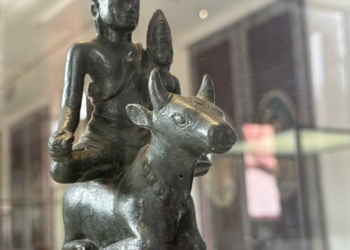
At Phnom Da, an ancient statue of Harihara (see above) rises with monumental calm. The right side: the upright bearing and princely regalia of Vishnu. The left: undulating locks and a tranquil, half-smile channeling Shiva’s otherworldliness. Though fractured by the centuries and once separated from its head, the statue’s eventual restoration became itself a narrative of return, memory, and resilience. The Khmer world’s heritage is inscribed not just in sacred texts but in the weathered faces of such devotional images.
Enduring Influence: Syncretism as Khmer Genius
Harihara’s appeal peaked during the pre-Angkorian era, yet its echoes have long reverberated in Cambodian art and religious thought. The impulse to integrate—seen most clearly in the Angkorian period’s architectural marvels, like the temples of Bakong and Banteay Srei—speaks to a cultural genius for synthesis. Temples once dedicated to either Shiva or Vishnu seamlessly housed other deities, including the Buddha, underscoring the uniquely Khmer approach to spiritual plurality.
Legacy: Balance, Power, and Identity
In the quiet gaze of a Harihara statue, one may perceive the Khmer penchant for mediation—between realms, between beliefs, between past and present. As the syncretic spirit of the early rulers, Harihara symbolizes not only a theological merge, but also the core strategy of Cambodian kingship, where legitimacy rested as much in an ability to reconcile as to rule. The story of Harihara thus unfolds as a story of Cambodia itself: resilient, integrative, and ever open to the currents—political, cultural, and spiritual—that have crossed its historic fields. The legacy of this dual god continues to inspire, a reminder that enduring power often emerges not from the strict purity of doctrine, but from the bold, harmonious fusion of opposites.