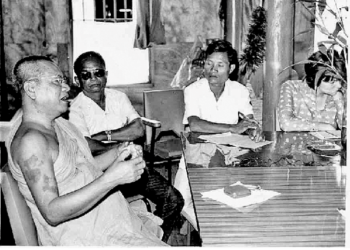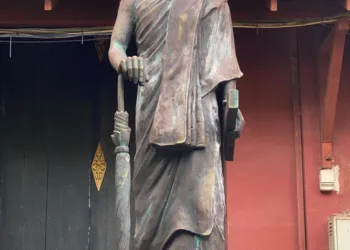

Chuon Nath (ជួន ណាត) (1883–1969) was a seminal figure in Cambodian history, renowned as a Buddhist monk, linguist, educator, and cultural guardian who played a pivotal role in preserving and promoting Khmer identity during a period of intense foreign influence and colonial rule.
Early Life and Education
Born on March 11, 1883, in Kampong Speu Province to a farming family, Chuon Nath was the elder of two sons. At age 12, he was sent to a Buddhist temple to study, following the traditional path for Khmer boys. He became a novice monk in 1897 and was fully ordained in 1904 at 21 years old. Demonstrating exceptional scholarly aptitude, he excelled in Pali, the sacred language of Theravada Buddhism, passing rigorous exams and later becoming a professor at the Senior Pali High School in Phnom Penh. In 1922, he furthered his studies in Sanskrit at the École française d’Extrême-Orient in Hanoi, reflecting his deep engagement with the classical languages foundational to Khmer culture and Buddhism.
Religious Leadership and Reform
Chuon Nath rose to become the Gana Mahanikaya Supreme Patriarch of Cambodia’s largest Buddhist order, the Mahanikaya Sangha. He led a reformist movement that emphasized a rationalist and scholastic approach to Buddhism, deeply rooted in linguistic and scriptural studies of the Pali Canon. This movement not only revitalized Cambodian Buddhism but also fostered a sense of national identity among Khmer monks and laypeople alike, at a time when Cambodia was under French colonial rule and facing cultural dilution.
Contributions to Khmer Language and Culture
One of Chuon Nath’s most lasting legacy was his work in preserving and modernizing the Khmer language. Recognizing the threat of French cultural dominance, he spearheaded efforts to Khmerize education and religion by creating new Khmer vocabulary derived from Pali and Sanskrit roots rather than borrowing from French. For example, he coined the Khmer word Ayaksmeyana for “train,” combining words meaning “metal” and “vehicle”.
In 1915, a royal decree established a committee to prepare a comprehensive Khmer dictionary, and Chuon Nath was a key member of this committee. After decades of work, the first edition of the Chuon Nath Dictionary was published in 1967, two years before his death. This dictionary remains a cornerstone of Khmer linguistic scholarship and is still widely used today.
Translation of Buddhist Scriptures
Chuon Nath also oversaw the translation of the entire Pali Canon — the foundational scriptures of Theravada Buddhism — into Khmer. This monumental task made Buddhist teachings more accessible to the Khmer people in their native language, strengthening both religious practice and national identity.
National Anthem and Nationalism
Beyond linguistics and religion, Chuon Nath contributed to Cambodian nationalism through cultural symbols. He is credited with authoring the lyrics of Cambodia’s national anthem, Nokor Reach, which emphasizes the unity of nation, religion, and monarchy — the three pillars of Cambodian identity. The anthem calls on all Khmers to remember their heritage and strive to restore the greatness of their country, reflecting Chuon Nath’s vision of cultural pride and resilience.
Legacy
Chuon Nath passed away on September 25, 1969, in Phnom Penh. His ashes were interred at Wat Ounalom, a significant Buddhist temple in the capital. Today, he is remembered as a visionary monk who not only preserved the Khmer language and Buddhist tradition but also helped shape modern Cambodian identity during a turbulent era. His work continues to influence Cambodian culture, education, and religion, making him an enduring icon of national pride and cultural guardianship.
Summary Table: Key Contributions of Chuon Nath

Chuon Nath’s life exemplifies dedication to preserving Cambodian cultural heritage through language, religion, and education, making him a towering figure in Cambodia’s 20th-century history.