Estimated reading time: 7 minutes – A short journey into Khmer religion, where Indian mythology acquired a distinctly Cambodian accent.
In Cambodia, Parvati is often better known as Uma, the powerful Hindu goddess who became closely associated with Shiva. Her images reveal how Khmer artists transformed Indian religious ideas into something unmistakably Cambodian.
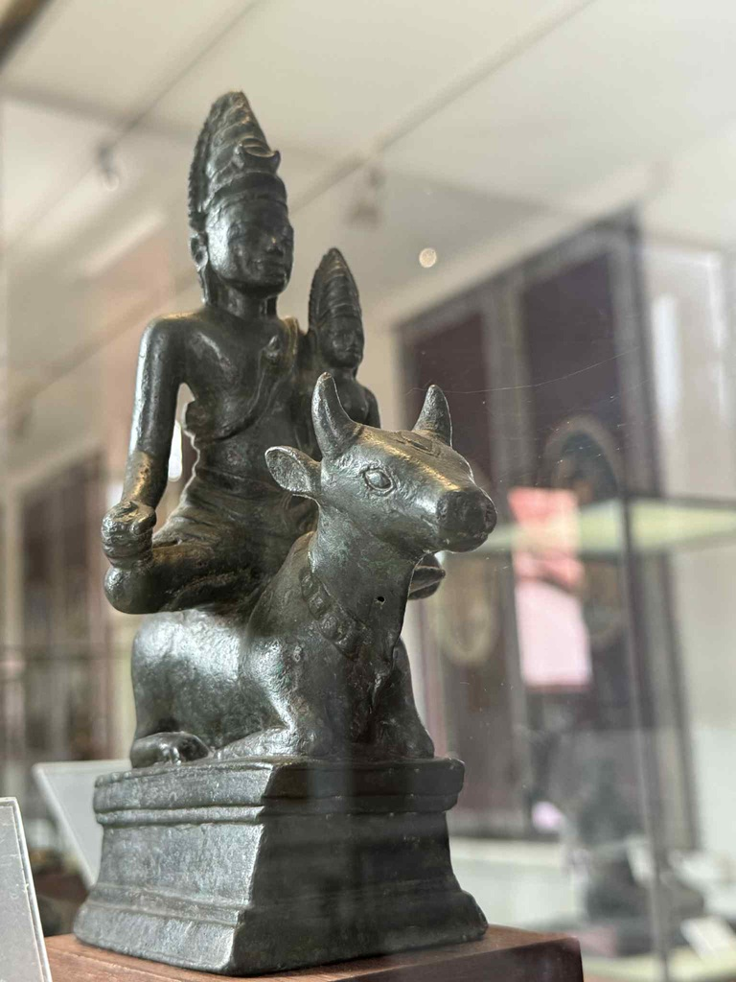
Parvati (ព្រះម៉ែបវ៌តី) is one of the most important goddesses in Hinduism, yet visitors exploring Cambodia may encounter her under a name that seems slightly different: Uma (នាងឧម៉ា). In Khmer religious art and temple sculpture, Uma is the feminine counterpart of Shiva, embodying fertility, power, beauty and divine energy.
For travelers, history enthusiasts and anyone interested in Cambodia’s religious heritage, understanding Uma provides a useful key to reading Khmer temples. Her statues are not simply decorative images of a goddess. They belong to a sophisticated religious world in which Indian mythology was absorbed, adapted and given new visual forms by Cambodian artists.
Parvati and Uma: Two Names, One Goddess
In Hindu tradition, Parvati is the daughter of the Himalayas and the consort of Shiva. Her name is associated with the mountains, while Uma is one of her many traditional names.
Hinduism has never been particularly economical with divine names. A single deity may have several names, each emphasizing a different aspect of personality, mythology or spiritual power. Parvati, therefore, is not unusual in appearing under different names and forms.
Uma is traditionally presented as a benevolent and graceful manifestation of the goddess. She can also appear as a more formidable figure, particularly when identified with other manifestations of divine feminine power such as Durga or Kali.
In Cambodia, however, the name Uma became especially familiar in connection with Shiva. Khmer religious art frequently presents the divine couple as Shiva and Uma, a pairing that reflects the importance of Shaivism in the religious history of ancient Cambodia.
Uma in the Religious World of Ancient Cambodia
Indian religious traditions reached mainland Southeast Asia over many centuries through complex networks of trade, diplomacy, intellectual exchange and cultural contact. Cambodia did not simply copy Indian religion. Khmer rulers, priests and artists adapted imported ideas to local circumstances.
Shaivism became particularly influential during several periods of the Angkorian era. Shiva was worshipped by kings and elites, and temples dedicated to or associated with him appeared throughout the Khmer world.
Uma naturally occupied an important position in this religious universe.
Her presence alongside Shiva expressed more than a divine marriage. In Hindu thought, Shiva represents a powerful cosmic principle, while his union with the goddess expresses the complementary relationship between masculine and feminine energies.
The subject also had an obvious appeal to Khmer royal ideology. Divine couples could symbolize fertility, prosperity, cosmic harmony and legitimate power. In a temple environment, an image of Uma therefore carried religious meaning while participating in a much larger symbolic system.
What Does Uma Look Like in Khmer Art?
Khmer representations of Uma vary according to period, artistic style and religious context. Many are elegant, composed figures with refined facial features and carefully arranged hair and clothing.
Like other Khmer female divinities, Uma can appear with a serene expression and an elaborate coiffure. Her clothing and jewelry provide clues to the period in which the sculpture was produced.
One of the pleasures of studying Khmer sculpture is noticing that divine figures were not carved according to a single rigid formula. Artists developed recognizable conventions, but they also introduced variations in posture, costume, ornamentation and facial treatment.
The result is a goddess who may be immediately recognizable as part of the Hindu pantheon while simultaneously looking unmistakably Khmer.
Uma and Shiva: A Divine Partnership
The relationship between Uma and Shiva is central to understanding her role.
Shiva is often associated with asceticism, destruction and transformation. He can appear as a terrifying deity, a meditating yogi or a powerful cosmic lord. Uma provides a complementary dimension, representing feminine energy, fertility, domesticity and creative power.
Their relationship is therefore not simply a mythological romance.
It expresses a fundamental Hindu idea: opposing or complementary forces can exist together and produce cosmic balance. Shiva without Shakti, the divine feminine power represented by the goddess, is spiritually incomplete.
This concept became particularly important in later Hindu traditions, but its roots are deeply embedded in the mythology surrounding Shiva and his consort.
For Cambodian viewers in the Angkorian period, an image of Shiva and Uma could consequently communicate ideas about cosmic order, divine authority and the harmonious union of complementary forces.
Uma, Durga and the Many Faces of the Goddess
It is important not to assume that every female deity in Khmer sculpture is Uma.
Cambodian temples contain representations of numerous Hindu goddesses and female divine figures. Identifying them requires attention to attributes, posture, companions, inscriptions and archaeological context.
Uma can also be understood within the broader concept of Shakti, the feminine divine power. In different traditions, this power appears through several manifestations.
Durga, for example, is the warrior goddess who famously battles the buffalo demon Mahishasura. Her imagery is generally more dynamic and martial than the serene representations associated with Uma.
Kali is another powerful manifestation, associated with destruction and time.
These distinctions matter when looking at Khmer sculpture. A graceful female figure standing beside Shiva is not automatically Durga, and a goddess with multiple arms and weapons should not casually be labeled Uma simply because she is female.
Ancient religious art rewards patience. The gods, fortunately, are rarely offended by careful looking.
Uma at Angkor and Beyond
The worship of Shiva and Uma was not confined to Angkor itself. Shaivite religious traditions spread widely across the Khmer Empire, leaving traces in temples and sculptures throughout present-day Cambodia.
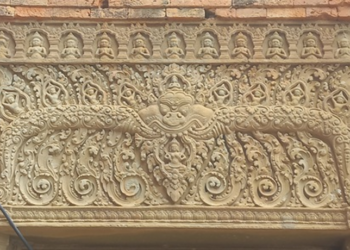
Sites such as Banteay Srei, with its exceptionally refined sandstone carvings, provide a vivid impression of the sophistication of Khmer Hindu art. Built in the 10th century, the temple is particularly famous for its detailed depictions of Hindu mythology.
Other temples associated with Shaivism reveal the broader geographical reach of these traditions. Inscriptions are especially valuable because they can help identify deities, donors and religious foundations that sculpture alone may leave ambiguous.
This is one reason Cambodian temples should be approached as historical documents rather than merely beautiful ruins. Architecture, sculpture and inscriptions often tell different parts of the same story.
Why Uma Matters for Understanding Cambodia
Uma is important not simply because she belongs to Hindu mythology, but because her presence illustrates the cultural transformation that took place in ancient Cambodia.
The Khmer civilization was deeply connected to the wider Indian Ocean and South Asian cultural world. Yet Cambodian religion was never simply an imported package.
Local rulers selected traditions that suited their political and religious needs. Khmer priests interpreted Sanskrit religious concepts within their own environment. Artists transformed Indian iconographic models into distinctive Khmer forms.
Uma therefore belongs to a fascinating process of cultural adaptation.
When we look at a Khmer sculpture of Uma, we are seeing the meeting of several worlds: Indian mythology, Cambodian religious practice, royal ideology and the individual creativity of Khmer artists.
That is what makes these sculptures so rewarding. They are neither purely Indian nor isolated from India. They are Khmer interpretations of a much wider Asian religious tradition.
How to Recognize Uma in a Cambodian Temple
For visitors exploring Cambodia’s temples, a few practical observations can help.
First, look at the figure’s relationship with Shiva. Uma is frequently represented as his consort, making the pairing an important clue.
Second, examine the attributes. Objects held in the hands can help distinguish one goddess from another, although many sculptures have lost their original details.
Third, consider the temple’s religious context. A strongly Shaivite temple provides a more plausible setting for an image of Uma than a monument associated primarily with another religious tradition.
Finally, do not rely on appearance alone. Khmer sculpture can be wonderfully subtle, and identification sometimes depends on inscriptions or specialist archaeological research.
A little caution is preferable to confidently identifying every elegant stone woman as “Parvati” and discovering later that she was somebody else entirely.
From Hindu Goddess to Khmer Heritage
The story of Uma in Cambodia is ultimately part of a larger story about cultural exchange.
Hinduism, Buddhism and local religious traditions interacted for centuries across the Khmer world. Gods could change prominence, religious institutions could evolve and temples could be transformed or reused.
Uma survived in Cambodian artistic heritage even as the religious landscape changed.
Today, her images are part of Cambodia’s extraordinary archaeological legacy. They remind us that Angkor was not merely an architectural achievement. It was also an intellectual and spiritual civilization whose artists translated complex ideas into stone.
For modern visitors, recognizing Uma adds another layer to the experience of Cambodian temples. What might initially look like a beautiful female statue becomes a doorway into mythology, theology, royal symbolism and the history of cultural exchange across Asia.
Conclusion
In Cambodia, Parvati is often encountered as Uma, the graceful yet powerful consort of Shiva and an important figure in the Hindu heritage of the Khmer world. Her sculptures reveal how Cambodian artists absorbed Indian religious traditions and transformed them into a distinctive Khmer visual language, leaving behind some of the most compelling evidence of ancient Cambodia’s spiritual imagination.
About the author
Pascal Médeville is a writer and digital publisher based in Cambodia. His work explores Cambodian history, culture, religion, language, heritage and everyday life, with particular attention to the stories and details that help make Cambodia’s past understandable to modern readers.