Estimated reading time: 6 minutes. A good six minutes for birds that can make a forest sound considerably more impressive.
Cambodia’s hornbills are among its most charismatic forest birds, from the imposing Great Hornbill to the more discreet Oriental Pied Hornbill. This article looks at four species associated with Cambodia, their appearance, behavior, habitat, conservation, and the remarkable role they play in maintaining healthy forests.
Introduction
Cambodia’s forests are home to some spectacular birds, and hornbills are perhaps the most theatrical of them all. Their oversized bills, strange calls, powerful flight and peculiar nesting habits make them difficult to confuse with anything else in the Cambodian avifauna. The generic name for hornbills in Cambodia is “keng kâng” (កេងកង), except for the wreathed hornbill, known in Khmer as “pveang” (ព្វាំង).
This article focuses on four hornbills relevant to Cambodia: the Wreathed Hornbill (Rhyticeros undulatus), Great Hornbill (Buceros bicornis), Oriental Pied Hornbill (Anthracoceros albirostris), and Tickell’s Brown Hornbill (Anorrhinus tickelli). The latter requires a small taxonomic and historical footnote, since modern Cambodian bird lists generally recognize the closely related Austen’s Brown Hornbill (Anorrhinus austeni) instead. Historical surveys, however, reported A. tickelli from southwestern Cambodia.
For travelers, birdwatchers and anyone interested in Cambodia’s natural heritage, these birds offer a particularly good way to understand the importance of old forests. A hornbill is not merely something impressive to photograph. It is also a useful indication of what is happening in the forest around it.
Hornbills and Cambodia’s forests
Hornbills belong to the family Bucerotidae, a group characterized by large, often brightly colored bills. Several species also possess a structure called a casque on the upper part of the bill. Despite its formidable appearance, this structure is not simply a gigantic weapon. Its precise functions vary between species and can include acoustic resonance and visual signaling.
The Cambodian hornbills considered here occupy different ecological niches, but they share an important dependence on forest habitats. Great and Wreathed Hornbills in particular are associated with mature forest, where large trees provide food and, crucially, suitable cavities for nesting. But note that it is not rare to see hornbills in Phnom Penh downtown.
Their diet is equally interesting. Hornbills consume fruit, but they are not exclusively vegetarian. Depending on the species, they may also take insects, reptiles and other small animals. Tickell’s Brown Hornbill, for example, has been recorded feeding on insects, centipedes, snakes, skinks, lizards, crabs and small mammals as well as fruit.
This varied diet makes hornbills active participants in the forest ecosystem rather than mere spectators with impressive beaks.
Wreathed Hornbill (Rhyticeros undulatus)
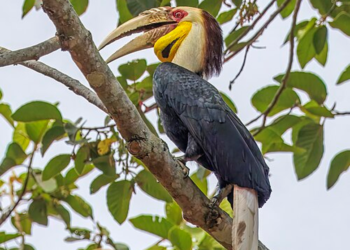
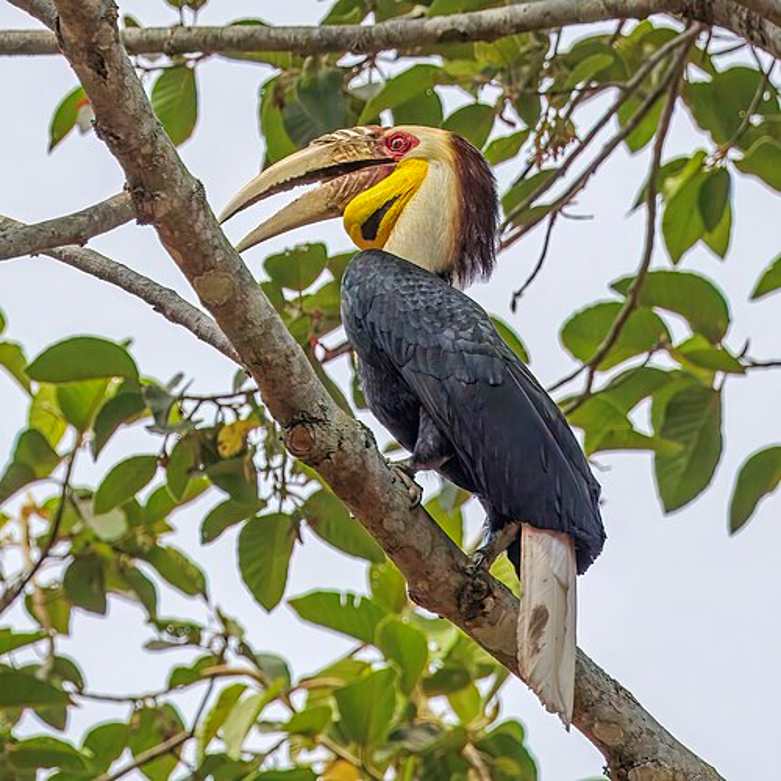
The Wreathed Hornbill (ព្វាំង pveang) is one of Cambodia’s great forest birds. It is a large hornbill with a long bill and a distinctive casque that develops ridges, or “wrinkles,” giving the species its English name.
The species is found across parts of South and Southeast Asia, including Cambodia. Its range encompasses evergreen and other forest habitats, and Cambodia remains part of its present-day distribution. The species is currently assessed as Vulnerable, reflecting the pressures faced by large forest-dependent birds.
One of the most memorable features of the Wreathed Hornbill is the difference between male and female birds. The male has a rufous crown and a prominent yellow throat area, while the female is predominantly black with a blue throat. The throat pouch is particularly distinctive and contributes to the bird’s sometimes rather eccentric appearance.
The Wreathed Hornbill also illustrates why protecting mature forest matters. Large hornbills require suitable nesting trees, meaning that simply having trees is not always enough. Forest structure and the survival of older trees can be critical.
Great Hornbill (Buceros bicornis)
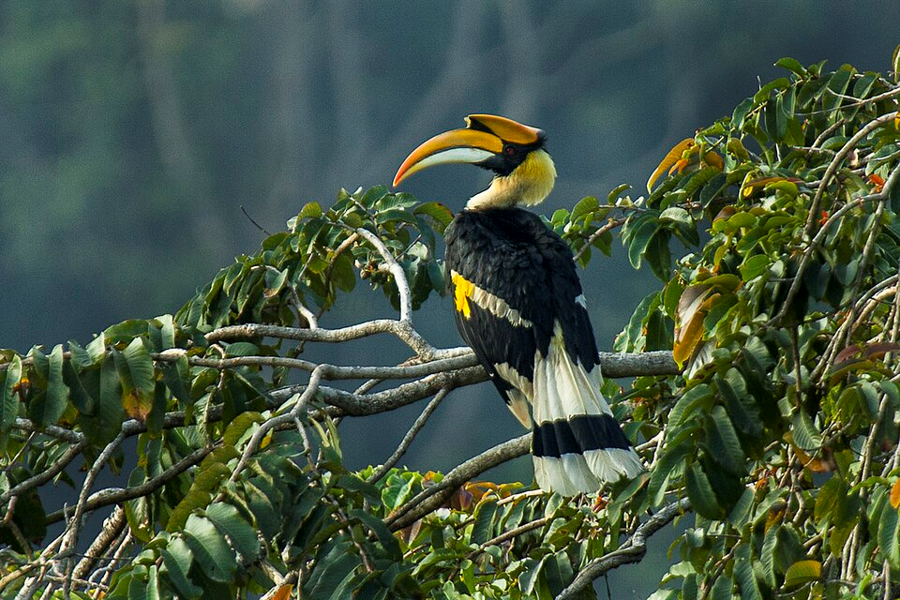
If hornbills had a department of grand entrances, the Great Hornbill (កេងកងធំ keng kâng thom “big hornbill) would probably be in charge.
With its enormous yellow-and-black bill, prominent casque, white wing markings and powerful flight, the Great Hornbill is one of Asia’s most spectacular birds. It is also one of Cambodia’s best-known large forest species.
The Great Hornbill is listed as Vulnerable in Cambodia’s bird checklist sources. Historical research on Cambodian hornbills found that populations of both Great and Wreathed Hornbills had declined significantly since the 1960s, while the smaller Oriental Pied Hornbill remained comparatively common.
Its dependence on large trees is particularly important. Hornbills use natural tree cavities for nesting, and the availability of sufficiently large mature trees can therefore determine whether a forest remains suitable for breeding.
The Great Hornbill is also an important fruit eater and seed disperser. By swallowing fruit and later moving through the forest, hornbills can transport seeds away from the parent tree. In ecological terms, they are helping the forest plant itself.
Oriental Pied Hornbill (Anthracoceros albirostris)
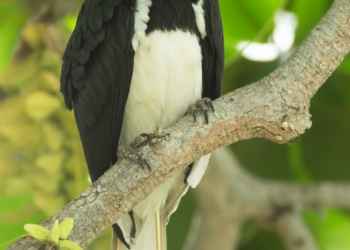
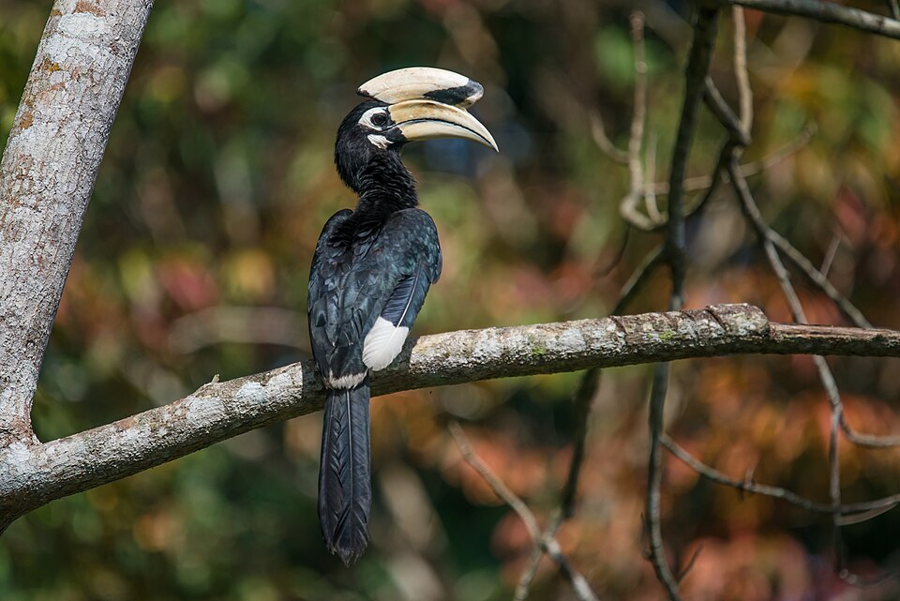
The Oriental Pied Hornbill (Khmer: កេកងតូច keng gang toch, “small hornbill”) is smaller and generally less imposing than its two larger relatives, but it is no less interesting.
It is a black-and-white hornbill with a prominent pale bill and casque. Compared with the Great and Wreathed Hornbills, it is more adaptable and can occur in a wider variety of habitats.
That adaptability has helped make the Oriental Pied Hornbill one of Cambodia’s more familiar hornbills. A Cambodian bird survey described it as occurring in a variety of habitats and being common throughout the country.
This difference between species is instructive. The presence of a hornbill does not automatically mean that a forest is pristine. Some species are considerably more tolerant of altered habitats than others. The survival of the larger, more forest-dependent hornbills tells us rather more about the quality and continuity of Cambodia’s remaining forests.
Tickell’s Brown Hornbill (Anorrhinus tickelli)
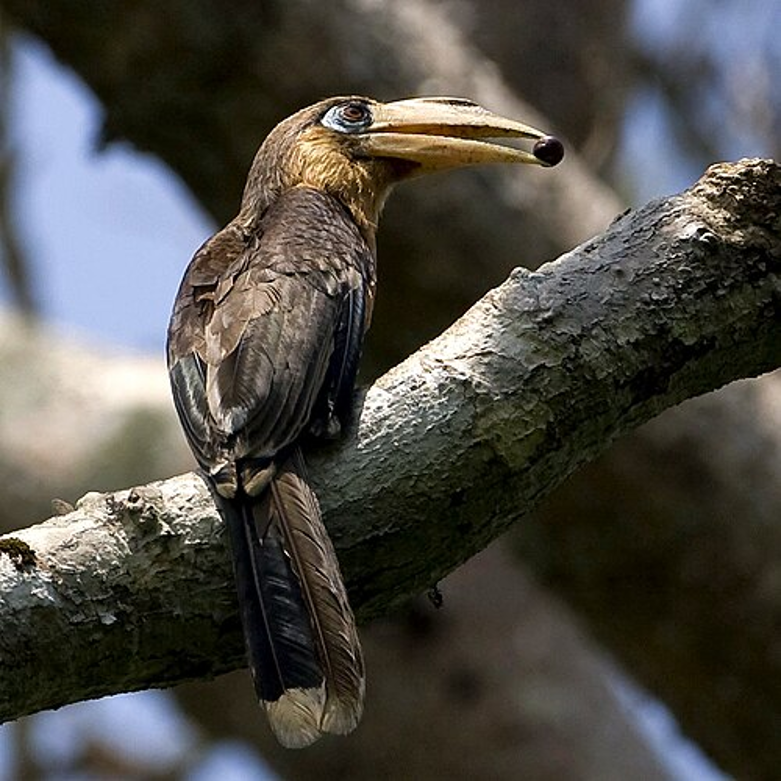
The Tickell’s Brown Hornbill (Khmer: កេងកងត្នោត keng kâng tnaot, “brown hornbill”) is the most complicated bird on this particular Cambodian list.
Historical Cambodian ornithological research reported Anorrhinus tickelli from Kirirom National Park, in the southwestern part of the country. A 2004 study described it as a fourth hornbill species recorded in Cambodia, following the three historically recognized species Great Hornbill, Wreathed Hornbill and Oriental Pied Hornbill.
There is an important modern qualification. The IUCN Hornbill Specialist Group currently describes Tickell’s Brown Hornbill as having a distribution in southern Myanmar and adjacent western Thailand, while current Cambodian bird checklists generally list Austen’s Brown Hornbill (Anorrhinus austeni) instead.
The distinction is not merely academic. Taxonomy changes as ornithologists obtain better evidence, and older Cambodian records may need to be interpreted in light of subsequent taxonomic revisions.
For a Cambodia-focused historical account, however, Anorrhinus tickelli deserves mention because its reported presence is part of the country’s ornithological record. It is also a reminder that Cambodia’s bird fauna is not a static catalogue. Species boundaries, distributions and identifications can become more complicated as research progresses.
Why hornbills matter
Hornbills are particularly valuable as seed dispersers. Fruit-eating species can swallow fruits and transport their seeds over considerable distances before depositing them elsewhere.
This makes them part of the forest’s natural regeneration system. Remove large seed-dispersing birds, reduce mature trees and fragment the forest, and the ecological consequences can extend well beyond the birds themselves.
Hornbills also have a remarkable breeding strategy. In several species, the female enters a tree cavity and seals the entrance, leaving only a narrow opening. The male then supplies food from outside while the female incubates the eggs and cares for the young.
It is an extraordinary arrangement, although from the male’s perspective it presumably involves rather more catering than most birds would tolerate.
The system works only when suitable nesting cavities exist. That is one reason why old trees matter even when they appear less economically useful than younger, faster-growing timber.
Where can you see hornbills in Cambodia?
For visitors interested in Cambodian birdwatching, the best opportunities are generally associated with the country’s remaining forest landscapes and protected areas.
The Cardamom Mountains, Kirirom area, and the forests of the Eastern Plains are particularly relevant to Cambodia’s larger forest birds. Local conditions, season, habitat quality and recent disturbance all affect the chances of seeing individual species.
Hornbills can be surprisingly easy to hear before they are seen. Their wingbeats can also be distinctive, especially when a large bird flies overhead. Patience is therefore useful. Rather than walking quickly from one viewpoint to another, spend time listening beneath the forest canopy and watching fruiting trees.
Early morning is usually an excellent time for birdwatching. Binoculars are far more useful than trying to approach a hornbill closely, and responsible observation should always take precedence over getting the perfect photograph.
Conservation begins with the forest
The story of Cambodia’s hornbills is ultimately the story of its forests.
The historical decline of Great and Wreathed Hornbills demonstrates how vulnerable large forest birds can be to habitat loss and hunting pressure. At the same time, the continued presence of Oriental Pied Hornbills shows that some species can adapt more readily than others.
Protecting hornbills therefore means more than protecting individual birds. It means conserving mature trees, maintaining forest connectivity, reducing hunting pressure and preserving the ecological conditions that allow hornbills to feed and reproduce.
In Cambodia, every large hornbill crossing a forest canopy is evidence that something in that ecosystem is still functioning.
Conclusion
The Wreathed Hornbill, Great Hornbill, Oriental Pied Hornbill and the historically recorded Tickell’s Brown Hornbill each tell a different part of Cambodia’s ornithological story. Together, they show why forests are valuable not only for their trees, but for the intricate relationships between birds, plants and landscapes. To protect Cambodia’s hornbills is, in considerable measure, to protect the forests that make the Kingdom’s natural heritage so extraordinary.
About the author
Pascal Médeville is a writer and digital publisher based in Cambodia and the founder of Wonders of Cambodia. His work explores Cambodian history, culture, everyday life, nature and heritage, combining accessible storytelling with a long-standing interest in the country’s rich cultural and natural landscape.