Not every doorway is meant to be crossed. At Phnom Chisor, one of Cambodia’s most remarkable temples, a beautifully carved false door reminds visitors that Khmer architecture was as symbolic as it was artistic. This short video invites you to discover one of the temple’s finest decorative masterpieces, where every stone tells a story nearly a thousand years old.
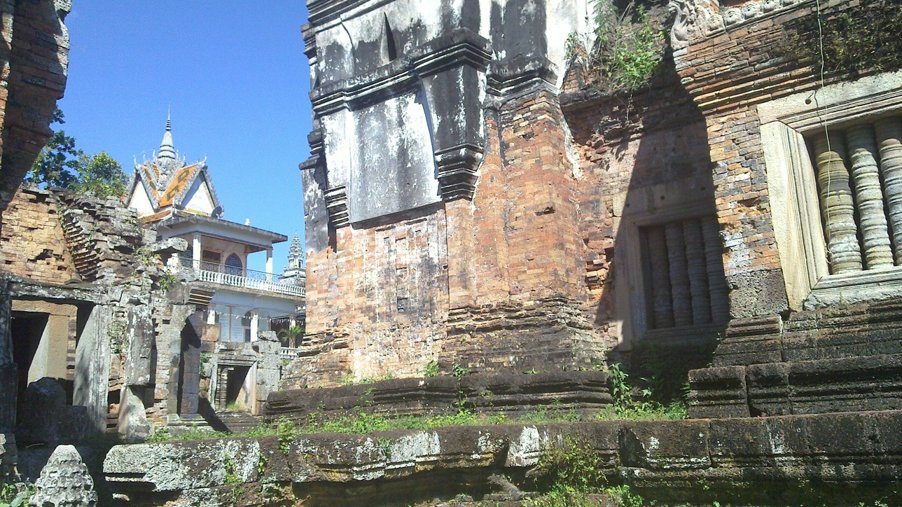
Some of the greatest treasures of Cambodia’s ancient temples are not always the largest. They often hide in plain sight, waiting for curious eyes to pause and admire the finer details. One such treasure is a magnificent false door of Phnom Chisor, an architectural masterpiece that perfectly illustrates the elegance and sophistication of Khmer craftsmanship.
Our latest video offers a close-up look at this remarkable feature, revealing details that many visitors overlook while exploring the temple.
A Door That Was Never Intended to Open
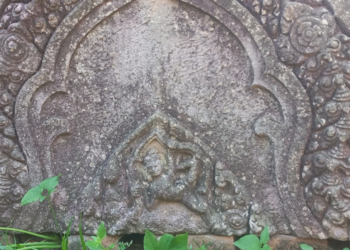
At first glance, the structure appears to be an ordinary doorway. It is framed by elegant colonettes and crowned with a richly sculpted lintel. Yet there is no passage beyond it.
This is a false door, one of the defining elements of classical Khmer temple architecture. While the sanctuary usually had a single functional entrance, the other sides often displayed carefully carved false doors that maintained the harmony and symmetry of the building.
These symbolic doorways represented sacred space rather than physical access. In Khmer religious architecture, symbolism often carried as much importance as practical function.
The Art of the Khmer Lintel
Above the false door stretches an exceptionally beautiful lintel, carved from sandstone with extraordinary precision.
Khmer sculptors transformed these architectural elements into works of art. Flowing vegetal motifs intertwine with divine beings, mythical creatures, and elegant scrolls that seem almost alive despite having been carved centuries ago.
Even after a millennium, the refinement of the carving remains striking, reminding us why Khmer art is considered among Southeast Asia’s greatest artistic achievements.
Phnom Chisor, a Temple Above the Plains
Perched atop a hill in Takeo Province, approximately 60 kilometers south of Phnom Penh, Phnom Chisor dominates the surrounding countryside.
Constructed during the reign of King Suryavarman I in the early eleventh century, the temple rewards visitors with spectacular panoramic views after climbing its long staircase. Beyond the impressive setting, Phnom Chisor preserves numerous examples of classical Khmer architecture, making it one of Cambodia’s most rewarding historical sites.
While many visitors admire the temple as a whole, details such as this false door reveal the astonishing level of artistry achieved by Khmer stone carvers.
More Than Decoration
False doors were never simply ornamental.
They contributed to the visual balance of the sanctuary while expressing religious concepts linked to the sacred world. Combined with elaborately carved lintels and colonettes, they created a harmonious composition in which every architectural element served both aesthetic and symbolic purposes.
Standing before this doorway that leads nowhere, one cannot help but appreciate how Khmer architects transformed stone into spiritual expression.
Watch the Video on Wonders of Cambodia’s Youtube channel: