

Perched on a lonely hill south of Phnom Penh, Phnom Chisor offers everything at once: Angkorian stones, Hindu gods, a working monastery and 400+ steps to test your karma. This is the rare day trip where history, countryside and a good leg work out all come in one neat, windswept package.
Introduction: Why Phnom Chisor Deserves A Day Trip
If you are staying in Phnom Penh and wondering whether there is more to see than traffic, cafés and the Royal Palace, Phnom Chisor (Khmer: ភ្នំជីសូរ) is your answer. This hilltop temple in Takeo Province combines 11th‑century Khmer architecture, wide‑open countryside views and a still‑active Buddhist monastery, all within a comfortable day trip from the capital.
This article is for travelers who enjoy a bit of history with their panorama, and who are not afraid of a staircase that goes on longer than they expected. You will learn what Phnom Chisor is, why it matters historically, how to get there, what to expect on site and how to make the most of your visit without collapsing halfway up the hill.
Think of Phnom Chisor as Angkor’s provincial cousin: smaller, quieter, but with its own proud story to tell. And there is a certain satisfaction in looking down at the rice fields and thinking, “Yes, I climbed all those steps for this.”

Where Is Phnom Chisor And What Exactly Is It?
A hill In Takeo, A World Away From Phnom Penh
Phnom Chisor (also written Phnom Chiso) is a 133‑meter‑high hill in Takeo Province, about 50–65 kilometers south of Phnom Penh, depending on your route. At its summit stands an Angkorian‑era temple, surrounded today by a modern Buddhist monastery. The combination makes the site feel both ancient and very much alive.

The temple itself is known as Prasat Phnom Chisor, and it sits just east of the summit on a flattened platform. From here you get broad views over the surrounding rice fields, ponds and villages — classic Cambodian countryside, but with a stone‑framed balcony seat.
From Sri Suryaparvata to Phnom Chisor
In the 11th century, this hill was known by a more ambitious name: Sri Suryaparvata or Suryagiri, Sanskrit for “Mountain of the Sun.” The temple was built during the reign of King Suryavarman I, one of the most important rulers of the Khmer Empire, who had a particular taste for hilltop sanctuaries.
Despite the solar name, Phnom Chisor is not a sun temple. Inscriptions and surviving sculptures show that it was dedicated mainly to Shiva, with a secondary dedication to Vishnu, reflecting the Brahmanic religion promoted by Suryavarman I. In typical Khmer fashion, royal politics, religion and landscape were fused into a single architectural statement.

A Short History of Phnom Chisor
Suryavarman I and his hilltop vision
Suryavarman I (r. roughly 1002–1050) is known for consolidating the Khmer Empire and for building or expanding temples far beyond Angkor itself. At Phnom Chisor, he commissioned a compact but sophisticated temple complex of laterite, brick and sandstone, adorned with carved lintels and framed by galleries.
The central shrine housed a linga named “Suryavameshvara,” cleverly blending the king’s own name with an epithet of Shiva, “lord of the world.” It is a typical Khmer move: if you are going to worship a god, you might as well make sure your own name is carved into the cosmic stonework.
Destruction, Restoration and Survival
Over the centuries, Phnom Chisor was altered, damaged and at times partially abandoned. Some brick towers on the site may predate Suryavarman I, and later periods added or reworked structures. In the early 1970s, the temple suffered bomb damage during the war, and many structures were left in a ruinous state.
Restoration efforts began in the 20th century, with documented work by the École française d’Extrême‑Orient in the 1930s and more recent repairs in the 2010s under the Cambodian Ministry of Culture and Fine Arts. Today, Phnom Chisor is once again solid enough to welcome visitors, while still retaining the slightly broken charm that makes Angkorian sites so photogenic.
Climbing Phnom Chisor: What to Expect
Let us address the main concern first: yes, you really will climb more than 400 steps. The long laterite staircase rises from the eastern plain up to the temple, and although the exact count varies by source, plan for around 412 stone steps. It is a steady, not technical climb, but in the hot season it can feel heroic.
The reward is not only the view from the top, but also the procession of smaller structures you pass along the way: lower temples such as Sen Thom and Sen Rong, remnants of ancient causeways, and the sense that this was once a carefully staged ceremonial ascent, not just an improvised stair-master.

- Start your climb in the morning or late afternoon to avoid the midday heat.
- Bring water, a hat and sunscreen — there is little shade on the stairs.
- Wear comfortable, non‑slippery footwear; some steps are worn and uneven.
- If you have serious mobility issues, consider enjoying the lower area and views without forcing the full climb.
At the top, allow time to catch your breath, then wander slowly; Phnom Chisor is not huge, but the details reveal themselves best when you are no longer gasping.
Exploring the Temple: Stones, Sculptures and Views
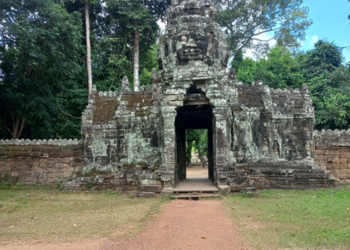
The upper temple complex is relatively compact: a rectangular enclosure with galleries, gates on the east and west, and a central sanctuary topped by multiple towers. Built mainly of laterite and brick with sandstone doorframes and lintels, it is a good example of the Khleang and Baphuon styles that bridge earlier and later Angkorian forms.
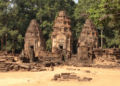
Inside, you will see the remains of six brick towers, a mandapa hall extended to the east, and two small fire shrines (vahnigriha), one of which still contains a linga. Doorframes bear inscriptions in ancient Khmer and Sanskrit; even if you cannot read them, you will sense the density of history carved into those narrow thresholds.
Sculptures, Inscriptions and the Countryside Below
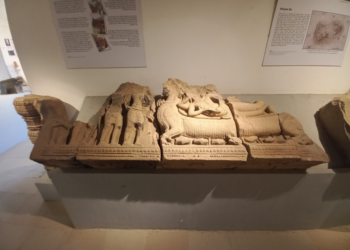
Fragments of reliefs and statues are scattered around the site: Shiva dancing, Vishnu reclining, and various bearded or unidentified figures that keep art historians busy. Much has been lost or weathered, but what remains is enough to give a feeling of the temple’s original richness.
Then there is the view. From the ruined galleries you look out over a patchwork of rice fields, ponds and villages stretching to the horizon. On clear days, you can see smaller temple sites aligned with Phnom Chisor, evidence of a broader sacred landscape once organized along geometric lines in good Khmer fashion. It is the kind of view that makes even non‑historians briefly philosophical.
Phnom Chisor Today: Monastery, Rituals and Local Life
Phnom Chisor is not just an Angkorian ruin; it is also home to an active Buddhist monastery, with modern pagodas and monk quarters just beside the ancient stones. This coexistence of Hindu ruins and Theravada practice is very typical of Cambodia, where old sacred sites are rarely left entirely to the archaeologists.
You may see monks and laypeople going about their daily routines, making offerings, or simply enjoying the breeze at the top of the hill. As always, dress modestly, be discreet with photography and remember you are visiting a place of worship, not just a scenic overlook.
Local Atmosphere and Best Time to Go
On weekends and public holidays, Phnom Chisor can be lively, with Cambodian families picnicking near the base and vendors selling snacks and drinks. On weekdays, it is usually quieter, and you may share the upper temple with only a handful of other visitors.
The dry season (roughly November to March) offers clearer views and easier access, though the countryside is arguably more beautiful when the rice fields are green. Either way, Phnom Chisor makes an excellent complement to a Phnom Penh stay, especially if you are not heading to Angkor on the same trip.
How To Visit Phnom Chisor from Phnom Penh
Phnom Chisor is typically visited as a day trip from Phnom Penh, often combined with another site such as Tonle Bati or a countryside village stop. You have three main options:
- Private car or taxi: The most comfortable and flexible, especially in the hot season.
- Tuk‑tuk or remork: Cheaper but slower; better if you enjoy wind and dust in equal measure.
- Organized tour: Many agencies offer full‑day trips including transport, guide, and sometimes a blessing ceremony with a local priest.
Road conditions are generally decent, though expect some bumpy segments once you leave the main highway. Figure on an eight‑hour outing in total for the typical organized day trip.
Entrance, Etiquette and What to Bring
Entrance fees are modest and may change from time to time; bring small cash in Cambodian riels or US dollars. As with other temples, shoulders and knees should be covered, and shoes must be removed when entering active shrine areas.
Useful things to bring:
- Water and light snacks (though basic vendors are often present).
- Sun protection: hat, sunscreen, sunglasses.
- Camera or phone with enough battery — there are many photo opportunities.
If you enjoy a more independent experience, you can hire a local driver in Phnom Penh and simply ask for Phnom Chisor, then negotiate waiting time for your climb and exploration.
Phnom Chisor is one of those places that quietly reward the traveler who makes a bit of effort: a hilltop temple from the age of Suryavarman I, a working monastery, sweeping countryside views and a staircase that will make your legs remember Cambodia long after your flight home. For visitors based in Phnom Penh who want more than cafés and city traffic, this ancient “Mountain of the Sun” is a perfect day trip — part history lesson, part pilgrimage, and part very practical exercise.
Pascal Médeville is a writer and digital publisher based in Cambodia. He runs Wonders of Cambodia, where he writes about Cambodian history, temples, everyday culture and the quieter corners that most itineraries skip. When he is not climbing staircases like Phnom Chisor’s, he is usually turning archival footnotes into readable travel stories.








Super Pascal merci pour cet excellent texte. J’écris un livre de voyages là je me promène dans ma mémoire qui flanche un peu et ton texte m’a rappelé le Phnom Chisor. Je remue des souvenirs de 1992 et là je me souviens de ce lieu alors livré à lui-même, j’avais oublié les marches, mais j’étais plus jeune aussi Je me souviens d’un petit orchestre qui jouait près d’une entrée et aussi d’une séance de divination en fait un jeune étudiant qui voulait savoir s’il allait réussir ses examens. Un acyar lui faisait cette séance dont j’ai oublié le nom khmer qui consiste à marquer la page d’un livre de textes sans doute plus ou moins ésotériques et d’interpréter le texte ainsi choisi.
Il y a aussi à l’est ce fronton avec Siva qui danse et joue de la vina (enfin je crois).Pour le reste, c’était encore pas mal ruiné, mais je m’apprêtais à faire le saut vers Siem Reap et c’était là une belle introduction.
Amitiés
Jacques
Bonjour Jacques,
Cela fait très longtemps que je ne suis pas allée au Phnom Chisor.
A vrai dire, les escaliers me font un peu peur.
Mais il paraît qu’on peut désormais y accéder en voiture. Ce sera l’une de mes prochaines escapades.
Amitiés,
Pascal