

In the luminous years before war and tragedy engulfed Cambodia, a new cultural rhythm began to echo from Phnom Penh’s radio waves and dance halls — the sound of electric guitars mixing with Khmer melodies. At the heart of this modern transformation stood Baksey Cham Krong, a pioneering group widely hailed as Cambodia’s first rock band. Formed in 1959 by teenage brothers Mol Kamach and Mol Kagnol, along with their friend Samley Hong, the band helped herald a musical revolution that mirrored the optimism of an independent nation finding its modern voice.

A Noble Name with Electric Spirit
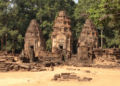
The band’s name, Baksey Cham Krong (បក្សីចាំក្រុង), was inspired by a 10th-century Angkorian temple meaning “The Bird Who Shelters the City.” It reflected both reverence for tradition and a desire to protect and renew Khmer culture. Like the temple, the band became a symbolic bridge between Cambodia’s glorious past and its dynamic post-independence age.
That blending of heritage and modernity embodied King Norodom Sihanouk’s cultural vision. Himself a passionate artist, Sihanouk encouraged creativity and cosmopolitanism, especially among Cambodia’s youth. In this fertile environment, the Mol brothers began experimenting with imported sounds from Western radio — notably, Cliff Richard and the Shadows, The Ventures, Chuck Berry, and Paul Anka. These influences shaped the group’s early style: smooth vocals blended with surf-rock guitar riffs and romantic overtones.
The Golden Age of Cambodian Rock
Throughout the early 1960s, Cambodia experienced a cultural golden age. Baksey Cham Krong were among its brightest stars. Their hit songs — such as Ne Penser Qu’à Toi (“Thinking Only of You”) and Pleine Lune (“Full Moon”) — carried lyrics in both French and Khmer, capturing urban sophistication while resonating with youthful emotion. Their performances, often held in Phnom Penh’s high school halls or broadcast on national radio, captivated a generation of teenagers eager to modernize and romanticize their identity.
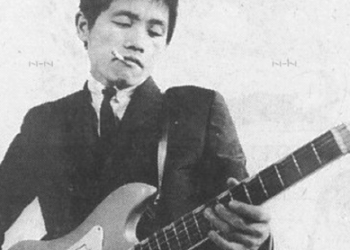
Mol Kamach’s crooning vocals invited comparisons with Pat Boone and Anka, while Kagnol’s lead guitar, at just fourteen years old, earned him the nickname “Uncle Solo.” The group’s charm and professionalism helped seed a movement — a wave of guitar-driven Cambodian bands that soon proliferated across the kingdom. They inspired legends like Sinn Sisamouth, who began infusing his repertoire with rock elements, bridging popular and modern idioms.
What made Baksey Cham Krong’s sound distinctive was not imitation but adaptation. They took Western rock ’n’ roll’s electric rhythm and infused it with Khmer sensibility — smoother harmonies, gentle tonalities, and lyrical modesty that reflected Cambodian cultural aesthetics. Their music was “innocently romantic,” as one commentator described, never loud or aggressive like Western garage rock, but intimate and melodic.
This unique fusion resonated across class lines. While Phnom Penh’s youth danced to electric beats in cafés, the songs also found acceptance among the traditional middle class. For a short, radiant moment, Cambodia felt in tune with the global 1960s spirit — modern, hopeful, creative, and connected.
The Curtain Falls: Breakup and Exile
In 1966, family expectations and limited career opportunities led to the group’s breakup. Both Mol brothers turned to studies — Kamach in finance and Kagnol in engineering — reluctantly leaving behind music at the peak of their fame.
Fate, however, was unkind. The Khmer Rouge regime of 1975–1979 decimated Cambodia’s artistic community. When Pol Pot’s forces captured Phnom Penh, Kagnol was training with the military in the United States; Kamach was in France. They escaped the genocide that claimed around two million lives, including many musicians and intellectuals. Tragically, over twenty members of the Mol family were killed.
From their respective exiles, the brothers kept the memories alive. Mol Kamach continued performing in France, his velvety voice gracing small community events and recordings. Mol Kagnol eventually settled in the United States, occasionally collaborating with younger musicians to preserve the legacy of Cambodia’s first rock guitar.
The story of Baksey Cham Krong might have faded into obscurity had it not been for a global rediscovery of Cambodia’s lost rock ’n’ roll era. The 2015 documentary Don’t Think I’ve Forgotten: Cambodia’s Lost Rock and Roll introduced this forgotten chapter to worldwide audiences, situating Baksey Cham Krong as the foundational act that ignited the 1960s scene.
That same year, the surviving band members reunited for a historic performance in New York City, sharing the stage with another pre-Khmer Rouge band, Drakkar. Audiences heard for the first time in nearly five decades the lyrical echo of Ne Penser Qu’à Toi, filled with both nostalgia and resilience.
Baksey Cham Krong’s influence has since inspired contemporary Cambodian and diaspora musicians — from The Cambodian Space Project to Dengue Fever — who reinterpret vintage rock through modern lenses. The recent reissue of their original 7-inch vinyl singles on the French label Akuphone has further cemented their place in world music history as symbols of creative rebirth.
Symbol of a Nation’s Lost Sound
Beyond the nostalgia, Baksey Cham Krong stands as a cultural monument — the genesis of Cambodian modern music and a bittersweet reminder of what was lost. Their story mirrors Cambodia’s trajectory: a small yet vibrant nation that embraced modernity, suffered devastation, and now seeks to reclaim its voice.
In interviews, Mol Kagnol recalled how, as teenagers, they simply wanted to have fun, listen to guitars, and make friends. Yet in doing so, they laid the foundation for an entire artistic identity — one that blended the energy of American rock with Khmer grace and romanticism.
Today, as Cambodia’s music archives are rebuilt and its youth rediscover forgotten vinyls, Baksey Cham Krong’s melodies ring once again across generations. They remind listeners that creativity endures even through silence and that music, at its heart, is an act of shelter — much like the temple whose noble name they bore.
Baksey Cham Krong’s Pleine Lune, Khmer version:






Comments 1