Long before the silence of Angkor’s jungle temples was broken by tourists’ footsteps, the mighty Garuda (Khmer: គ្រុឌ krud) stood watch over Cambodia’s sacred spaces. Half man, half bird, Garuda swept into Khmer spiritual life from the fires of ancient Indian epics, bringing with him tales of power, deliverance, and eternal rivalry with the serpentine Naga. In Cambodia, Garuda isn’t just a myth or a memory—he’s a vivid presence sculpted in stone and whispered in legend, a guardian whose story is woven into the identity of a people.

Garuda’s roots stretch back to the Mahabharata, where he hatches after centuries in an egg, a radiant force unleashed to liberate his mother from captivity. Driven by filial love, he outwits gods and demons, stealing the elixir of immortality from the heavens and earning himself the honor of carrying Vishnu, the great preserver, across the cosmos. This saga of struggle and loyalty was embraced by the Khmer, who welcomed both the story and its wondrous hero into their land.
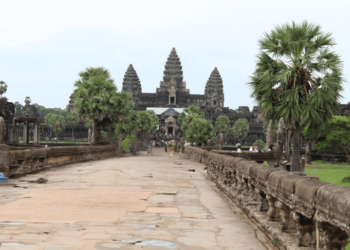
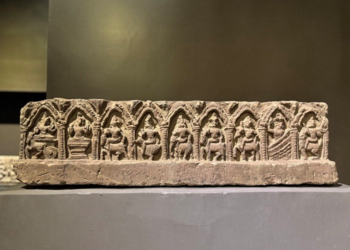
Across Cambodia’s sacred landscape, representations of Garuda abound. Step into Angkor Wat or Preah Khan, and his silhouette appears on lintels and pediments, locked in eternal battle with the ever-present Nagas. These artworks do not simply portray victory—they embody a cosmic dance of order and chaos, light and shadow. In Koh Ker, a forgotten capital swallowed by forest, a monumental Garuda stands, wings outstretched, subduing serpents underfoot in a gesture of dominion and divine authority.
Khmer kings understood Garuda’s power. In the royal courts, his image adorned thrones and ceremonial regalia, a signal that sovereignty was sanctioned by higher forces. To place Garuda at the temple or palace entrance was a declaration: this space is protected; evil must turn away. The myth’s resonance was reflected in daily life, as artisans shaped amulets and talismans in his likeness, worn by those seeking protection and strength.
Yet Garuda’s role in Cambodia did not stop at conquest or royal symbolism. In Buddhist tales, he became less a destroyer than a guardian—his enmity for the Nagas transformed into a symbol of vigilance, guiding souls on the path to enlightenment. Carvings from Siem Reap to Koh Ker sometimes depict Garuda and Nagas together, combining their strengths to support the Buddha and his teachings. In these scenes, the cosmic battle gives way to peaceful coexistence and spiritual aspiration.
Cambodian folklore adds its own layers. One tale recounts the story of Preah Thong and his father-in-law, the Naga king: when Garuda’s image is placed on the stairway of a castle, the Naga is forced to sneak inside via a hidden well, illustrating the enduring rivalry even in domestic affairs. Such stories feed into the everyday spiritual world, with Garuda seen as a force for good fortune and safety, his legend invoked in prayers and rituals.
In modern Cambodia, Garuda endures as both motif and guardian. His likeness adorns temples and homes; his tale inspires dance, sculpture, and ceremonial art. Through centuries of change, conquest, and restoration, Garuda remains—a bridge between earth and heaven, chaos and peace, myth and memory.
To see Garuda in Cambodia is to witness the enduring soul of Khmer heritage: powerful, protective, and ever watchful, with wings forever poised to rise above the shadows.