The Reamker (Khmer: រាមកេរ្តិ៍, transcription Rāmakerti) is one of Cambodia’s greatest literary and artistic treasures, a timeless epic that has shaped the country’s cultural imagination for centuries. It is the Khmer version of the Indian Ramayana, but far more than a simple adaptation. Over time, it has been infused with local values, beliefs, and traditions, becoming a distinctly Cambodian story that has guided moral lessons, artistic performances, and national identity.

The Reamker is far more than a tale about gods, demons, and heroes. It is also a mirror of Cambodian society, showing how ideals of loyalty, honor, and justice are passed down through storytelling. Engraved on temple walls, performed in classical dance, and retold through generations, the story of the Reamker has remained at the heart of Khmer culture.
Origins of the Reamker
The origins of the Reamker lie in the Indian epic Ramayana, which was introduced to mainland Southeast Asia through ancient trade, religious texts, and cultural exchanges, especially during the height of the Angkorian period when Hinduism was prominent. However, in Cambodia, the story evolved into something more than just a translation. The creators of the Reamker adapted the tale to reflect Cambodian beliefs, social codes, and Buddhist morals.
Unlike the Ramayana, which is rooted deeply in Hindu cosmology, the Reamker integrates many Buddhist elements. The emphasis is often not just on divine destiny but on moral responsibility and karmic consequences. In this way, the epic reflects Cambodia’s gradual shift from Hinduism to Buddhism while preserving its shared ancient heritage.
The Plot and Main Characters
The Reamker follows the life of Prince Preah Ream (Rama) and his battle against the demon king Krong Reap (Ravana). It begins with Preah Ream’s exile from his kingdom, accompanied by his wife Neang Seda (Sita) and his loyal brother Preah Leak (Lakshmana). Their journey into the wilderness sets the stage for trials of loyalty, temptation, and strength.
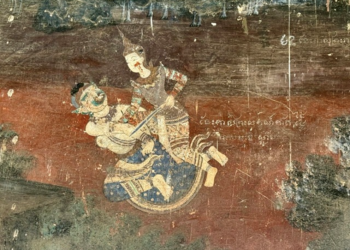
Neang Seda is captured by Krong Reap, leading to the great war that defines the story. To rescue her, Preah Ream allies with Hanuman, the clever and courageous white monkey general, and his army of monkeys. After fierce battles filled with supernatural encounters, trickery, and trials of faith, Krong Reap is finally defeated. The story concludes with triumph, yet also with an underlying lesson about human frailty, as doubts about Seda’s purity challenge the resolution.
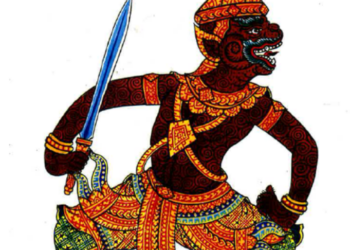
Among all characters, Hanuman, the monkey general, holds a special place in Cambodian storytelling. Beloved for his cleverness, bravery, and humor, Hanuman is often given greater freedom in Cambodian retellings, including sequences of romance and mischief absent in other versions of the epic. This reflects the Cambodian love of blending solemnity with playfulness, giving the Reamker a distinctive flavor.
Artistic Expressions of the Reamker
The Reamker is most widely recognized through its artistic expressions, particularly in classical dance and temple art.
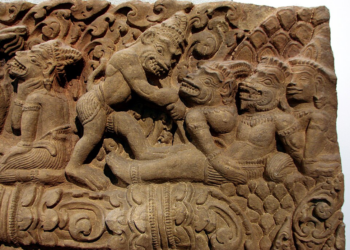
- Temple carvings: The walls of Angkor Wat and other sacred sites are filled with elaborate bas-reliefs depicting scenes from the Reamker, immortalizing its heroes and villains in stone. These carvings are not mere decorations but serve as teaching tools, illustrating morality, heroism, and cosmology to generations of Khmer people.
- Classical dance-drama: Perhaps the most vivid expression of the Reamker is found in the Lakhon Khol (masked dance) and the Royal Ballet of Cambodia. Through intricate hand gestures, elegant movements, and elaborate costumes, dancers bring the epic’s characters to life. Performances often emphasize moral struggles, divine intervention, and the balance of power between good and evil.
- Shadow theater: The Reamker is also performed through Sbek Thom, the sacred shadow puppet theater of Cambodia. Large, intricately carved leather puppets are illuminated against a screen, with puppeteers and musicians narrating the story. This ancient tradition was once performed only during ritual or royal ceremonies, underscoring the epic’s sacred importance.
Cultural Significance
The Reamker is not just a work of literature or art, but a moral and spiritual guide. It teaches values of loyalty, duty, compassion, and justice—qualities deeply ingrained in Cambodian culture. For instance, Preah Ream’s loyalty to truth and justice mirrors the virtues expected of a righteous king. Neang Seda embodies perseverance and dignity through hardship. Hanuman represents wit and devotion, reminding audiences that wisdom is as important as strength.
Moreover, the Reamker illustrates the constant tension between good and evil, a theme that resonates with Cambodia’s history, where struggles for survival and cultural resilience are recurring experiences. In the Khmer worldview, the story is also about balance, showing that even great heroes must confront doubt and moral dilemmas.
Adaptation and Endurance
What makes the Reamker so enduring is its adaptability. Throughout centuries, it has absorbed local folklore, regional tastes, and shifting religious ideas. During the Angkorian period, Hindu aesthetics infused it with grandeur. In later centuries, as Buddhism became dominant, the epic integrated compassion and moral karma into its storytelling.
Even during times of national hardship, such as the colonial era or the upheavals of the 20th century, the Reamker survived as a carrier of cultural memory. Its performances and depictions symbolized resilience, reminding Cambodians of their unity and moral heritage.
Today, the Reamker remains alive not only in temples and formal performances but also in contemporary interpretations. Modern choreographers, artists, and writers continue to revisit the epic, finding in it fresh inspirations and timeless truths.
The Universal and the Particular
The global spread of the Ramayana shows its universal appeal, but the Cambodian Reamker stands as a brilliant example of how epics take root in local soils. It is at once universal in its themes and deeply particular in its Khmer spirit. Its inclusion of playful characters, Buddhist moral undertones, and uniquely Cambodian artistic forms makes it unlike any other version in Southeast Asia.
The Reamker tells of triumph not just on a battlefield but in the human heart, where loyalty overcomes adversity and wisdom tempers strength. It is this blend of grandeur and intimacy, cosmic struggle and everyday lessons, that has allowed the story to persist so vividly in Cambodian life.
Conclusion
The Reamker occupies a unique place in Cambodian heritage. It is a living epic that connects past and present, myth and morality, art and identity. For the Cambodian people, it is more than a borrowed story—it is their own, reshaped into a cultural masterpiece that has endured across centuries. Whether reflected in the carvings of Angkor or the graceful movements of a royal ballet, the Reamker continues to tell the story of Cambodia itself: resilient, imaginative, and eternally striving for balance and justice.