Hanuman in the Cambodian Reamker is a white monkey general, a battlefield talisman, and, just to complicate things delightfully, a bit of a romantic lead. If you come from the Indian Ramayana, you may think you know him — until you meet his Khmer incarnation, leaping across Angkor walls and royal ballet stages with acrobatic enthusiasm.
This article is for curious travelers, mythology lovers, and anyone who has ever stared at an Angkor bas‑relief and wondered, “Why is that monkey flirting in the middle of a war scene?”. We will look at who Hanuman is in the Reamker, how Cambodia has reshaped him, and where you can actually see him today in dance, sculpture and popular culture.
Along the way, we will meet a few demons, a golden mermaid, and a very human sense of humor that is distinctly Khmer, even when the characters have tails.

Who is Hanuman in the Reamker?
In Cambodian mythology, Hanuman (Khmer: ហនុមាន) is the white monkey warrior who serves Preah Ream (Rama) in the Reamker, the Khmer adaptation of the Ramayana. He combines divine origin, supernatural powers and an almost mischievous loyalty that often steals the spotlight from his royal master.
Unlike some Indian tellings where Rama’s divinity dominates, the Reamker tends to humanize the prince and give more space to dynamic secondary figures — Hanuman very much included. His courage, cleverness and sometimes cheeky behavior make him a favorite of Cambodian audiences, especially in performance.
- Hanuman is usually referred to by the same name in Khmer, though embedded in a Khmer-speaking universe (Preah Ream for Rama, Neang Seda for Sita, Reap for Ravana).
- He is commander of the monkey army and the indispensable strategist and doer of impossible tasks: leaping over seas, infiltrating enemy cities, and burning down fortresses when needed.
- His defining trait in Cambodia, as elsewhere, is devotion — to Preah Ream, to the just cause, and to the cosmic order, now colored by Khmer Buddhist ethics.
Powers, Personality and a Very Khmer Sense of Humor
Hanuman in the Reamker does not suffer from modesty in the powers department. Cambodian tellings emphasize his capacity to change size, fly, and outwit demons with a combination of trickery and brute force.

- Super strength: He can defeat giants and demons, and his muscular, upright body in Khmer art underlines that.
- Shapeshifting: He can become huge to terrify enemies or tiny to spy and infiltrate, a favorite device in Cambodian narratives.
- Flight and speed: As son of the wind, he crosses oceans and realms in a single bound, which conveniently keeps the plot moving.
- Invulnerability: Many Cambodian stories present him as resistant to fire, sorcery and weapons, turning him into a nearly indestructible hero.
Character: loyal, clever… and playful
The Cambodian Hanuman is not a solemn ascetic.
- He is witty and enjoys verbal and practical jokes, especially at the expense of arrogant demons.
- He uses disguises and psychological tricks as much as brute force, embodying the ideal of clever courage rather than mere brawn.
- His playfulness fits the general tone of the Reamker, where solemn moral lessons coexist with delightful moments of comic relief.
You could say he is the ideal Khmer dinner guest: brave if the house catches fire, sharp in conversation, and never entirely serious for too long.
From Indian Ramayana to Khmer Reamker: What Changes for Hanuman?
The Reamker is not a simple translation of the Ramayana but a thorough cultural adaptation. Hanuman’s core remains recognizable, yet Cambodia gives him extra narrative space, more humor, and even a romantic life.
A more prominent, more human hero
In many comparative studies, scholars note that Hanuman’s role in the Reamker is amplified compared with classical Indian versions.
- He appears in more episodes and often takes the narrative lead in key adventures.
- His emotions — joy, anger, desire, mischief — are foregrounded, making him feel closer to a human hero with divine abilities than a purely mythic being.
One of the most beloved “Khmer twists” is the episode with Suvannamaccha, the golden mermaid princess.
- When Hanuman builds a causeway across the sea, demons sabotage it by sending a mermaid army under Suvannamaccha to remove the stones.
- Instead of just fighting, Hanuman does the sensible thing and falls in love with their leader.
- The two eventually reconcile their missions, and some Cambodian versions give them a son, Macchanu, who later appears as a heroic figure in his own right.
This romantic subplot is far more developed in Southeast Asian retellings, and in Cambodia it adds tenderness (and more opportunities for dance) to Hanuman’s already rich profile.

Hanuman on Stage: Lakhon Khol and the Royal Ballet
If you really want to understand Hanuman in Cambodia, you should see him dance. Classical performance traditions have given him some of their most spectacular choreography and costumes.
Lakhon Khol: masked male dance-drama
Lakhon Khol, a form of masked dance-drama performed by male troupes such as Lakhon Khol Wat Svay Andet (now on UNESCO’s Intangible Heritage list), features Hanuman as one of its most athletic roles.
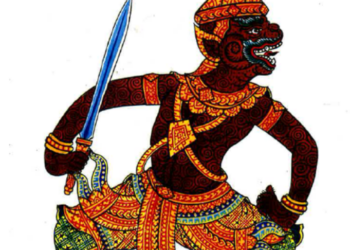
- Dancers wear elaborate monkey masks and high-crested headdresses, with bodies adorned in intricate patterns echoing temple bas-reliefs.
- Hanuman’s movements are fast, acrobatic and expressive: leaps, spins, and playful gestures that show both his martial skill and his sense of humor.
In the Royal Ballet, where roles may be danced by women as well, Hanuman remains a star of the show.
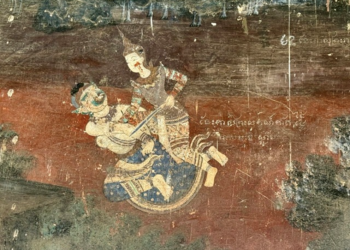
- His scenes with Suvannamaccha are particularly appreciated, combining flirtation, martial grace and slow, stylized underwater gestures.
- For visitors, spotting Hanuman in a performance is often easier than following the full plot: look for the white monkey with brilliant costume and irrepressible energy.
For anyone exploring the Reamker, watching Hanuman in live performance is the quickest route from text to living tradition.
Hanuman in Stone and Bronze: Tracing Him Across Cambodia
Even if you never attend a performance, Hanuman is waiting quietly (or not so quietly) in Cambodian art, especially from the Angkorian period.

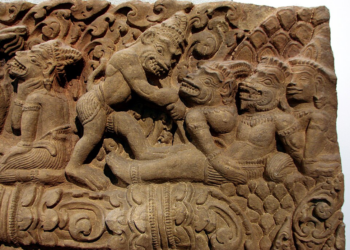
- Bas‑reliefs at Angkor Wat and other temples depict scenes from the Reamker, with Hanuman leading monkey armies against demon forces.
- He often appears mid‑leap or engaged in combat, surrounded by fellow monkeys scaling walls and attacking giants, carving motion into stone.
- These images not only illustrate the epic but also assert royal power and cosmic order, with Hanuman as an emblem of victorious service.
Sculptures and battle standards
Museums and collections preserve Angkorian bronzes of Hanuman, including powerful small statues that once crowned standards carried into battle.
- A 12th‑century bronze from Angkor (Bayon style) shows Hanuman in an exuberant martial pose, both monkey and man, radiating confident energy.
- As son of the wind god and symbol of success in war, such images turned him into a protective emblem for those who marched behind the banner.
From temple walls to museum vitrines, you can literally follow Hanuman across centuries of Khmer visual imagination.
Hanuman in Contemporary Cambodian Culture
Hanuman has not retired with the last Angkor king; he remains very much alive in modern Cambodia.
- Artists continue to draw, paint and sculpt Hanuman, often blending traditional motifs with contemporary styles.
- He appears in comics, educational materials and popular media aimed at teaching children about national heritage.
- Cultural events and festivals frequently feature Reamker-based performances where Hanuman is the role everybody wants to play — or at least photograph.
In short, the white monkey has successfully made the jump from royal courts to YouTube, which is not a bad career path for a mythological general.
Why Hanuman Matters in the Cambodian Imagination
Hanuman’s importance in Cambodia is not only aesthetic; it is also ethical and emotional.
- He represents loyalty to a just cause, yet with enough independence of mind to act creatively.
- His near invincibility is balanced by vulnerability to love, creating a character that feels strong but not cold.
- Through him, the Reamker expresses themes of courage, moral responsibility and the transformative power of devotion, reinterpreted through a Buddhist‑inflected Khmer worldview.
For readers and travelers, following Hanuman through the Reamker is a way to understand how Cambodia has absorbed an Indian epic and made it its own — tail, tricks, mermaid romance and all.
Hanuman in the Reamker is Cambodia’s white monkey hero: warrior, trickster, lover and cultural icon, embodying Khmer values of courage, devotion and joyful creativity in both ancient art and living performance.
Sources & further reading / To know more
- Reamker overview – Asia Society – Clear introduction to the Cambodian Ramayana, its history and key themes, useful for situating Hanuman’s role in context.
- Hanuman: The White Monkey God of the Khmer Reamker – Mythlok – Detailed article on Hanuman’s traits, powers and modern cultural presence in Cambodia.
- Comparison of Valmiki Ramayana and Cambodian Reamker – Hindu Blog – Accessible comparison highlighting how characters like Hanuman change between Indian and Khmer versions.
- Hanuman and Suvannamaccha – Bibliolore – Short study of the mermaid episode and its particular development in Khmer and regional traditions.
- Hanuman Angkorian bronze – Cleveland Museum of Art – Museum entry for a 12th‑century Khmer Hanuman sculpture, with description and high‑quality images.
- Reamker: Cambodia’s Epic of Good and Evil – Wonders of Cambodia – General presentation of the epic with emphasis on characters such as Hanuman and the blend of gravity and humor.
Pascal Médeville is a writer and digital publisher based in Cambodia, where he spends an unreasonable amount of time reading temple walls and performance schedules. He writes mainly about Khmer culture, history and literature for online projects such as “Wonders of Cambodia,” with a particular fondness for characters like Hanuman who dance cheerfully between worlds.