Phnom Penh is a city reinventing itself daily — fast, noisy, generous, and occasionally baffling. Beneath its cranes and cafés lies a place still defined by warmth, humor, and contradictions. This is what it actually feels like to live in the Cambodian capital as a foreigner today: beautiful, imperfect, and never quite what you expect.

Phnom Penh doesn’t reveal itself all at once. It greets newcomers with bright smiles, surprising efficiency, and traffic that moves according to laws known only to itself. Some arrive for work, others for curiosity, a few simply because the city has a way of capturing wanderers who meant only to pass through.
If you’re wondering what living here truly feels like — beyond the glossy travel shots and expat chatter — this guide is for you. It’s an honest picture of the small pleasures, modern transformations, and cultural quirks that shape everyday life for foreigners in Cambodia’s captivating capital.
Over the last few years, Phnom Penh has grown vertically and emotionally. High-rise apartments now share the skyline with pagoda spires, and international cafés jostle for space beside family noodle shops. The city hums with ambition — cranes swing across the horizon by day, street vendors roll up at dusk, and somewhere in between lies its real rhythm.
Yet despite its rapid growth, Phnom Penh hasn’t lost the relaxed, openhearted tempo that defines Cambodia. The smiles are still spontaneous, the hospitality unforced, and time itself seems more negotiable here than elsewhere.

Every sense is put to work: the scent of lemongrass and charcoal mingling with incense, motor engines, and evening jasmine. Phnom Penh keeps you alert. The air pulses with contrast — ancient and modern, quiet and kinetic — all somehow fitting together like threads in a generous, untamed tapestry.
The housing market reflects the city’s transformation. New condominiums gleam across Tonle Bassac and BKK1, while leafy streets hide elegant French-era townhouses adapted for modern living. Rent remains moderate — $400 to $800 (or more) a month depending on taste, balcony view, and stubbornness in negotiation.
Electricity and Wi-Fi are reliable enough for digital nomads, though the occasional power flicker still reminds residents that progress, here, remains slightly negotiable.
Urban mobility is surprisingly convenient. App-based rides, motorbikes, and bicycles weave smoothly through traffic’s organized anarchy. The key is adaptation: move with awareness, assume everyone else has a plan (even if you can’t see it), and discover that rhythm trumps speed when crossing any intersection.

Foreigners in Phnom Penh wear many hats — teachers, entrepreneurs, consultants, artists. Remote work is on the rise, cafes double as offices, and coworking spaces hum with quiet ambition. Lunch hours stretch into conversations, and the boundary between work and sociability stays blissfully porous.
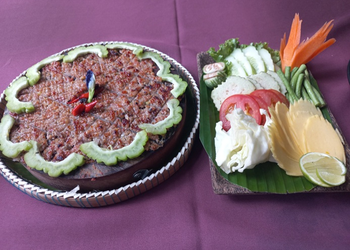
Food remains Phnom Penh’s great unifier. Morning markets burst with vegetables, herbs, and fish fresh from the Mekong, while elegant riverfront restaurants reinterpret those same ingredients for cosmopolitan tastes. The average foreigner’s diet quickly adapts to rice mornings, noodle afternoons, and barbecued evenings, punctuated by seriously strong iced coffee.
Phnom Penh’s social life thrives in paradox. You can sip a craft beer under fairy lights, then wander into a late-night street stall for tapioca pudding. Foreigners blend into a crowd that feels natural — Cambodian and international at once — bound by curiosity rather than nationality. The lines blur fast here, and that’s part of the charm.
Even a few Khmer phrases open doors. Locals appreciate the effort, and smiles widen perceptibly when you greet someone in their language. Mastery isn’t required — sincerity is. Over time, you discover that gestures, laughter, and shared meals achieve more than vocabulary lists ever could.
Challenges: The Art of Adaptation
Life here is rarely dull, sometimes sweaty, and occasionally dusty. The climate insists on humility; every foreigner eventually learns which hours belong to the sun and which to the shade. Air conditioners are champions of survival, and evening walks along the river become ritual purification.
Administrative life in Cambodia can feel like a long meditation. Visas, work permits, and business documents all demand patience — but rarely hostility. There’s always someone willing to help if you approach with courtesy and time to spare. The reward is a soft lesson in flexibility, more cultural than bureaucratic.
Phnom Penh sings in several registers: construction at dawn, temple bells by afternoon, riverside music by night. Expatriates who stay usually learn to interpret noise as a form of life rather than an intrusion. Somewhere between the chaos, serenity appears — often wrapped in the scent of fresh mango.
Why People Fall (and Stay) in Love with Phnom Penh
A place that forgives and welcomes
Phnom Penh doesn’t demand you be perfect; it invites you to adapt, to start something new, to get things wrong and laugh about it later. Its people are remarkably open to difference — not just tolerant but genuinely curious, often amused, and quietly proud of their heritage.
For many foreigners, what keeps them here is possibility. The city is small enough to be personal and large enough to reinvent you. One day you’re learning Khmer numbers at the market; the next you’re helping open a café, curating art, or publishing a book. Phnom Penh rewards initiative far more than credentials.
The city’s beauty isn’t polished — it’s improvised. A child feeding pigeons on the riverside, a sudden monsoon sweeping dust into perfume, monks crossing a zebra line in orange silk — these are its quiet miracles. To live here is to notice them, again and again, and call that awareness “home.”
Living in Phnom Penh as a foreigner is an experience of constant learning and gradual understanding. It’s not luxury or chaos that define it, but humanity — warm, patient, slightly mischievous. The city asks you to slow down, listen carefully, and let go of certainty. Do that, and you might discover not just a place to live, but a way to feel more alive.
Sources & further reading / To know more
- Khmer Times – Lifestyle: Current reporting on Phnom Penh’s changing neighborhoods and expatriate life.
- Move to Cambodia (Lina Goldberg): Insightful guides on housing, visas, and daily living across Cambodia.
- Expats in Cambodia – Facebook: A lively online community sharing advice, stories, and local discoveries.
- Phnom Penh Post – Lifestyle: Articles exploring culture, city dynamics, and local entrepreneurship.
- Lonely Planet – Phnom Penh: Updated overview for newcomers seeking cultural landmarks and experiences.
- Asia Life Cambodia – Facebook: In-depth features on lifestyle and emerging trends in contemporary Cambodia.
Pascal Médeville is a writer and digital publisher based in Cambodia. His work explores the textures of Southeast Asian life — from urban evolution to cultural memory and language. Through Wonders of Cambodia, he chronicles how the country’s heart beats beneath its modernization.